

Church Food Banks and the Persistence of Poverty
Contributed by: Miki (Cadre ACP)
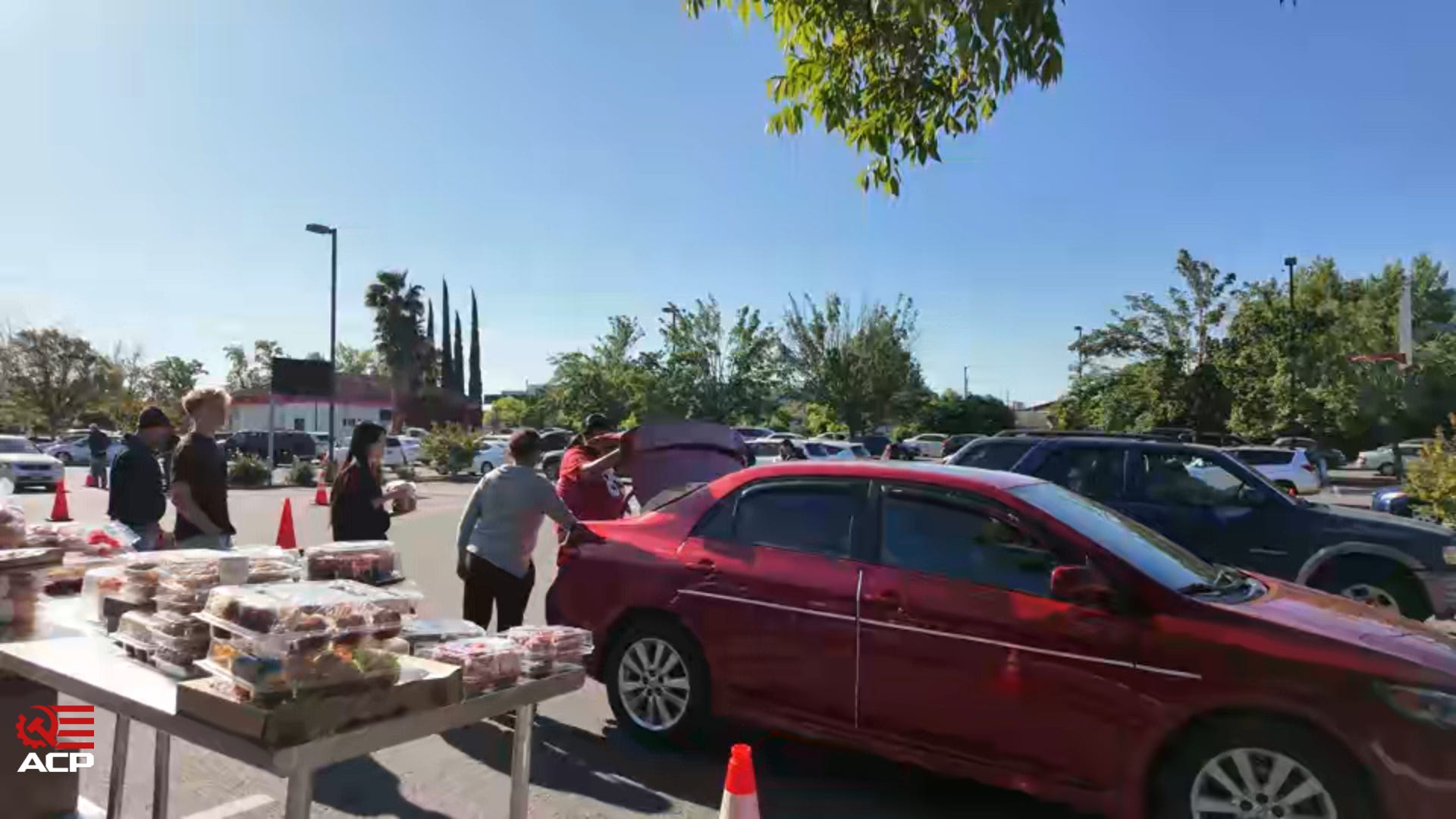
Food insecurity in Sacramento has been a major focus of research for ACP Central Valley members over the past year. We found that in Sacramento, more than 300,000 people now rely on food banks, up from about 150,000 before the COVID pandemic. Among them are over 80,000 children, along with a similar number of seniors. Churches and food banks where we’ve volunteered report an unprecedented surge in people seeking food assistance, while also facing growing challenges in trying to meet that need.
Over roughly a dozen volunteer visits at church-run food banks, we’ve watched lines of cars wrap around parking lots for hours. Volunteers move quickly, handing out boxes filled with essentials: canned goods, protein, fruits, and vegetables. For these congregations, this work grows directly out of their religious commitment to serve those in need. Yet, these church-run food programs seem caught in a difficult balance of delivering essential help while functioning within a system that continues to create the need for that aid.
Church food pantries are rarely standalone operations. They are embedded in a multilayered system of public and nonprofit support. At the federal level, programs source large quantities of food, while state systems augment and coordinate distribution through regional food banks. These food banks, in turn, partner with local institutions (churches), who rely on volunteers to deliver food to communities. Churches serve as critical access points within this network. By hosting food programs, they become visible and trusted community hubs, building relationships with families, schools, and local organizations. These activities also strengthen institutional credibility with donors, partners, and public agencies.
While both The ACP and the ministry leaders agree on the importance of providing immediate help, perspectives diverge when addressing the causes of poverty. Some religious leaders we have interviewed emphasize that poverty is a persistent, even inevitable condition, and that the primary response and solution are spiritual rather than political.
At The ACP, we do not see poverty as a permanent feature of human society but a product of specific economic arrangements. Wealth is created collectively, yet concentrated in the hands of a few. From this perspective, treating poverty as inevitable risks overlooking the structural conditions that give rise to it.
Contrary to common misconceptions about Karl Marx’s views on religion, he approached the subject with care and nuance. He saw it as a source of comfort and meaning, particularly in a system that leaves millions in hardship, while also recognizing how it can be used to divert attention away from the material causes of suffering. Applied to modern food distribution systems, this critique suggests that while food banks provide essential relief, they often operate within a framework that discourages deeper questioning of the economic structures behind food insecurity.
Food banks, including those run by churches, clearly meet urgent needs, and that work deserves recognition. However, if the conditions that create food insecurity remain unchanged, the demand for these programs will continue, and likely grow. This, again, does not diminish the value of the work being done. Rather, it highlights a structural dynamic: relief efforts can coexist with, and sometimes stabilize, the systems that produce the need for relief.
When asked how the local government could better support their programs, we noticed some leaders were hesitant to offer even constructive criticism. That hesitation makes sense when we consider the realities they operate within: many church-based food programs depend on partnerships with public agencies, access to government-supported food supplies, and close coordination with regional food banks and nonprofits. These relationships provide the resources needed to sustain large-scale distribution, but they can also create incentives to remain cooperative rather than critical in interactions with local authorities.
Additionally, the internal priorities of religious institutions, such as maintaining stability, serving their congregations, and focusing on pastoral care, often shape how political issues are approached. An emphasis on values like humility, patience, and endurance can support individuals facing difficult circumstances, but may also encourage a less confrontational stance toward their underlying causes. It is important to note that religious responses to poverty are not uniform. Both historically and today, different movements have interpreted religious teachings in ways that call for systemic change alongside direct aid.
Liberation theology in Latin America, which combined religious doctrine with analysis of economic inequality and support for social movements is one obvious example. At home, faith-based participation in labor organizing and civil rights campaigns have been the key components of some of the brightest moments in our country’s history. Church-run food banks play a vital role in addressing immediate needs. They provide food, stability, and a point of connection for thousands of individuals and families. Their work is grounded in genuine commitment and deeply held moral convictions.
At the same time, their position within a larger system raises important questions. When poverty is treated as inevitable and political engagement is limited, relief efforts risk becoming part of a cycle in which symptoms are managed while underlying causes remain intact.
The challenge, then, is not to question the necessity of feeding those in need, but to consider how such efforts relate to broader discussions about why that need exists, and whether it must continue at its current scale.