

The Arrest of Fergie Chambers in Spain: The Only Legal Things to Send to Gaza are Bombs
Contributed by: Christopher Urena (Cadre ACP)
On July 10th 2026, acting on orders coming down directly from the Audiencia Nacional (the Spanish high court)—which was responding to an Interpol Red Notice initiated by the Trump DOJ (Department of Justice)—Spanish authorities arrested Fergie Chambers (née James Cox Chambers Jr.) in Ibiza. Authorities reportedly surrounded his vehicle and removed him as he traveled through the city with his family. The crown-forsaking Cox heir turned Marxist-Leninist is currently being held in Madrid, having been denied bail by a judge via video call. His legal team is actively appealing the decision, and the case will soon be heard by the National Court in Madrid.
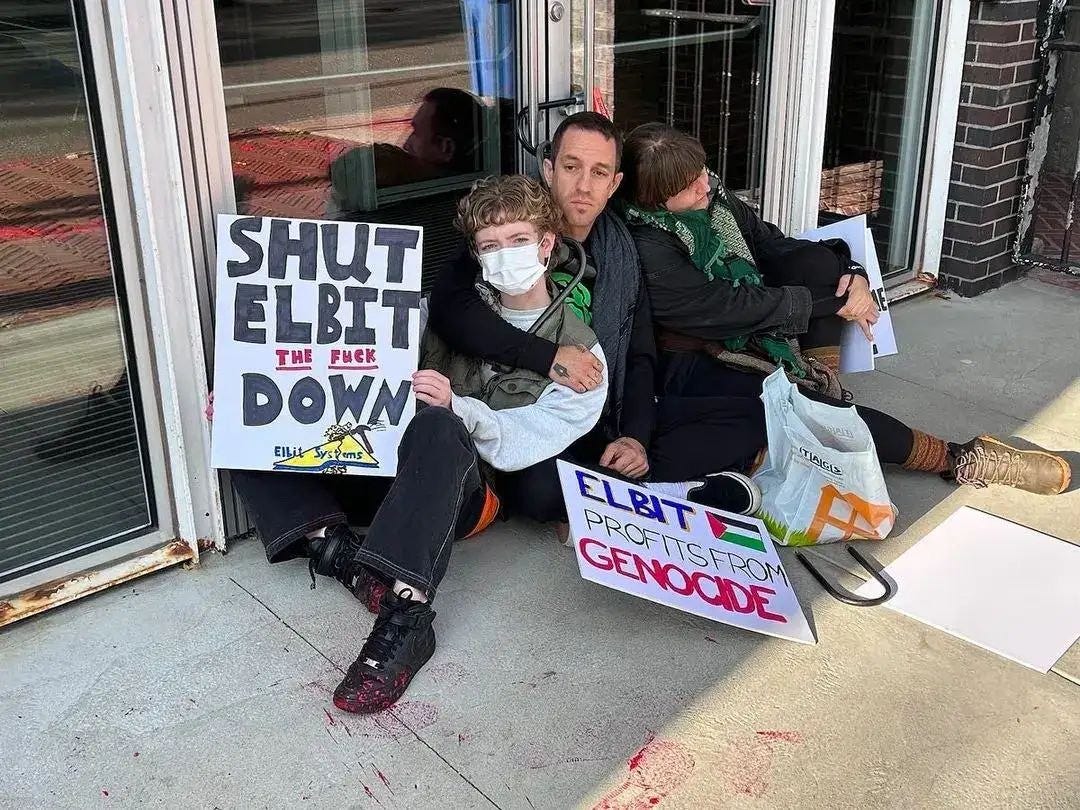
Chambers is a familiar face to many on the left, as well as to regular consumers of conventional American journalism—he’s been profiled by Rolling Stone and Vanity Fair (much to his chagrin), as well as being the subject of a recently released Sundance documentary. Chambers has a long history of significant political involvement. He participated in the Dakota Access Pipeline protests, organized against the Atlanta police expansion project (”Cop City”), and founded communes in Georgia and Massachusetts. He has also done journalistic work in the Donbas and Ukraine, funded Palestine Action, and participated in the 2023 demonstration against the Elbit Systems location in New Hampshire. Notably, Chambers paid the bail for three of the eight people arrested at the Elbit protest. One of those individuals was fellow activist Calla Walsh, with whom Chambers has maintained close ties for years following her placement on the board of his Babochki Collective—the entity created to steer his wealth toward socialist causes. Furthermore, Chambers has donated over $1 million to humanitarian projects supporting those affected by the Gaza genocide.
While the full details regarding the charges against Chambers have not been publicly revealed, he faces up to 30 years in prison for alleged “international money laundering… with the intent to provide material support to and resources to foreign terrorist organizations.” His family maintains that the charges constitute political persecution from the Trump DOJ. According to The Grayzone, a review of the sealed indictment offered no concrete evidence toward those charges, stating instead that Chambers made transfers from U.S. banks to Tunisian accounts totaling $7.5 million. Chambers lived in Tunisia, where he invests in local businesses and sponsors the local football team, Club Africain. His case marks the first known instance of the U.S. government seeking the extradition of an American citizen for allegedly supporting Hamas.
According to Spanish media, Chambers did not have a pronounced presence in Spain prior to his arrest. However, his detention triggered an immediate reaction from the Spanish left. Parties like Podemos called for a cacerolada (a pot-banging protest), and numerous politicians signed a letter to the Minister of the Interior opposing the extradition. In the U.S., the news has heightened fears stoked by the president’s renewed campaign against communism. The recent electoral success of the Democratic Socialists of America (DSA) has prompted a series of outbursts from the administration. During a July 3rd event at Mount Rushmore, Trump lambasted communism as “the greatest threat to our country, including World War I, World War II, Pearl Harbor, or even 9/11.” Meanwhile, Marco Rubio is reportedly convening an international gathering to address the “resurgence of transnational far-left terrorism.”
The extradition request also comes amid souring diplomatic relations between Spain and the US; Spain recently refused to allow its NATO joint military bases to participate in the American operations against Iran, while Trump threatened trade cuts over an uncooperative partnership. Scorned by Spain, the White House has ostensibly identified Chambers as the perfect target for its expanding initiative to punish anti-Zionist resistance domestically and now abroad. This strategy relies on the abuse of both national and international law to conflate legitimate humanitarian aid with material support for terrorism.
Though seemingly the latest expression in a conspicuous pattern of political repression from the Trump White House, the abuse of Interpol is as old as the system itself and is frequently weaponized through the pretext of financial crime. Because Interpol rules forbid interventions based on purely political motives like “treason,” countries often fabricate financial charges or exploit legal gray areas like the “financing of terrorism.” By abusing this framework, regimes can trigger arbitrary border detentions, freeze bank accounts, and cancel passports. Since the widespread digitization of Interpol, the number of active Red Notices has exploded tenfold over the last 15 years, with financial crime serving as the second-largest driver of extraditions to the U.S.
If Spain is truly opposed to Israel and authentically in solidarity with Palestine—as its actions on the international stage suggest, including its formal recognition of Palestine and the mutual removal of ambassadors—then the case of Fergie Chambers should register as yet another opportunity to stand against the Zionist regime. However, the swift denial of bail through a Zoom call is a concerning development that raises doubts about Spain’s commitment to its anti-Zionist ideals.